5/7/2026

WE ARE LOOKING FOR IMPACT UNICORNS

SPRIND Innovationsmanager Zarah Bruhn on the new SPRIND.Society

A summary of this conversation first appeared in Table.Briefings (Research.Table) .

With SPRIND.Society, Zarah Bruhn aims to elevate social innovations to the same level as technological ones. The goal is to unburden the state while simultaneously strengthening society. However, a crucial factor for social innovations – just as it is for others – is the return on investment.

The Federal Agency for Breakthrough Innovation (SPRIND) is broadening its focus: through SPRIND.Society, the agency will now specifically promote social innovations. The first projects are already underway, but the official launch takes place this week. In an exclusive pre-launch interview with Table.Briefings, Zarah Bruhn, the SPRIND manager in charge of the initiative, explains why this endeavor is not about mere niceness, but rather about tangible, hard-nosed economic impact.

Zarah Bruhn
Zarah Bruhn, Innovationsmanagerin at SPRIND

MS. BRUHN, UNTIL NOW, SPRIND HAS PRIMARILY STOOD FOR TECHNOLOGICAL BREAKTHROUGHS. WHAT EXACTLY IS CHANGING WITH THE NEW SPRIND.SOCIETY DIVISION?

We are broadening our definition of innovation. Previously, our focus was on technological breakthrough innovations – for instance, in fields such as nuclear fusion, Alzheimer’s research, or carbon-free cement. Now, we are adding the social sphere to the mix. Our goal is to identify disruptive innovations that can save the state billions while simultaneously improving the lives of millions of people. This encompasses topics such as education, the welfare state, digital inclusion, and democracy. Crucially, we view social and technological innovations as two sides of the same coin; we conceive them together. Technology-driven social solutions, in particular, hold enormous potential – and that is precisely where SPRIND.Society comes in.

THE NAME SPRIND ITSELF CONTAINS THE WORD BREAKTHROUGH INNOVATION. WHAT EXACTLY SHOULD ONE IMAGINE WHEN THINKING OF A SOCIAL BREAKTHROUGH INNOVATION?

It is not about philanthropic engagement; it is about generating a social return. We are looking for projects with genuine potential for scale. In other words, we ask ourselves: Which innovation creates measurable added value for society – whether through reduced bureaucracy, improved education, or more efficient government processes? One example is AI-powered educational software – already successful in Sweden – that significantly boosts learning outcomes in mathematics, particularly among disadvantaged students. Another is a project like WeFix.Social, which makes the welfare system more user-friendly by presenting benefits in an accessible, easy-to-understand format, thereby drastically cutting down on red tape.

YOU MENTION SOCIAL RETURN. HOW DO YOU MEASURE THAT?

We operate based on a clear benchmark: our projects must have the potential to generate up to one billion euros in social added value – whether through cost savings or through positive macroeconomic effects. We call these Impact Unicorns, drawing an analogy to classic unicorn startups. This means that solutions must be scalable and address real-world problems on a large scale. It is not enough to function well locally – the ambition is to achieve systemic impact.

ISN'T THAT HARDER TO PIN DOWN THAN TECHNOLOGICAL INNOVATIONS?

Yes, because there is no established definition for it yet. But the underlying logic is similar: Companies, too, are regularly disrupted by innovations. In the public or social sectors, however, this happens far too rarely. This is precisely where we see our role: as bridge-builders. We identify promising ideas, provide seed funding, and help integrate them into existing systems – for instance, through collaborations with government ministries or public agencies.

SPRIND IS STATE-FUNDED YET ENJOYS SPECIAL FREEDOMS. HOW CAN YOU LEVERAGE THIS UNIQUE ROLE WITH REGARD TO SOCIAL INNOVATION?

Many excellent solutions fail not because of the idea itself, but because of the market entry process – particularly in the education or social sectors. We aim to overcome these hurdles. As part of a federal agency, we have direct access to government ministries and can strategically position innovations. At the same time, we view ourselves as a platform for external ideas: we organize challenges, specifically reach out to startups, and mobilize innovative potential from outside the public administration.

SO, YOU INTEND TO FOCUS PRIMARILY ON EXTERNAL IMPULSES?

Absolutely. The best ideas for innovation rarely emerge from existing, established structures. They originate all across the country – within startups, civil society, or the research community. Our mission is to identify these ideas, provide the funding to get them off the ground, and pave the way for their practical implementation. This also involves adapting successful models from abroad. In the social sector, copying is expressly encouraged; traditional competitive dynamics or IP-related logic simply do not apply. If something works well elsewhere, we should adopt it.

CAN YOU PROVIDE AN EXAMPLE FROM ABROAD THAT SHOULD BE REPLICATED IN GERMANY AS QUICKLY AS POSSIBLE?

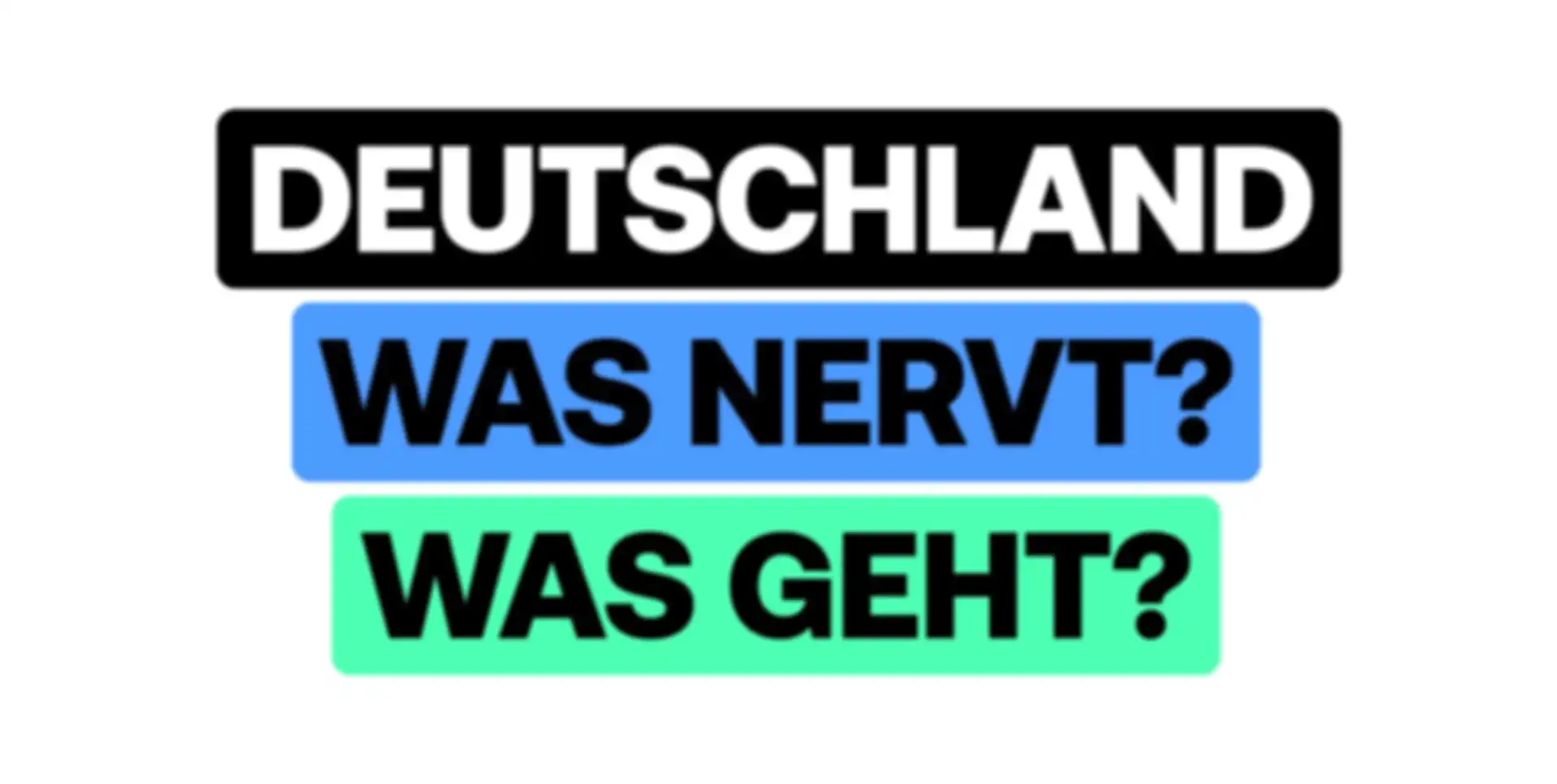
A prime example involves digital participation models, such as those found in Taiwan. There, they have succeeded in significantly boosting public trust in government institutions through innovative formats for citizen engagement. With our initiative, Germany what sucks? Germany what's up?, we aim to bring this demonstrably successful system here and raise awareness of it. We are also looking abroad for inspiration in the realm of funding models. In the UK, there are models in which state support is directly tied to the societal impact of a social breakthrough innovation – for instance, the number of people a project helps get into employment. This creates new incentives and has fostered a robust ecosystem.

WHAT OTHER TOPICS DO YOU INTEND TO TACKLE RIGHT FROM THE START?

Education is a key area – one where we aim to be among the global leaders. In parallel, we are focusing intensively on the welfare state, retirement provision, financial literacy, and state modernization. Another example lies in the realm of social media: We are currently evaluating a project working on a competitive algorithm designed to reduce polarization and, conversely, strengthen connections. That would be a classic moonshot – one that, if successful, would have enormous positive societal repercussions.

HOWEVER, TRADITIONAL PROJECT FUNDING INITIATIVES ALSO SEEK OUT SOLUTIONS OF THIS KIND. WHAT DISTINGUISHES YOUR WORK FROM CONVENTIONAL FUNDING PROGRAMS?

We enjoy significantly greater freedom and can act with greater agility. Above all, however, we take a different approach: We do not provide long-term funding for projects; instead, we always think in terms of milestones and systems. This means we do not merely ask whether an idea is sound, but also how it can be translated into practice – and what broader societal impact it will generate. To achieve this, we employ a variety of instruments, ranging from results-based financing to strategic partnerships.

HOW LARGE IS YOUR TEAM WITHIN SPRIND – AND WHAT RESOURCES DO YOU HAVE AT YOUR DISPOSAL?

We are currently a small team of four people, though we are continuing to expand the department. Financially, we are tied to SPRIND’s overall budget – which means we are in competition with other focus areas, such as nuclear fusion. At the same time, however, we benefit from SPRIND’s infrastructure, its established funding instruments, and its wealth of experience.

HOW IMPORTANT IS EFFECTIVE COMMUNICATION IN THIS FIELD? ULTIMATELY, ISN'T IT ALSO ABOUT MAKING DEMOCRACY AND ITS INSTITUTIONS A BIT MORE APPEALING AGAIN?

We want to foster a positive understanding of technology and innovation while simultaneously demonstrating that anyone can be part of this evolution. It is no longer just about paying taxes and then complaining. We actively invite people to contribute their ideas and help shape the future. At the same time, we also engage with the government and public administration, making it clear: there are clever solutions out there – but they actually have to be utilized. And if, in the end, democracy and its institutions experience a boost in public standing, that is certainly a welcome side effect.

WHAT DRIVES YOU PERSONALLY, AND HOW MUCH OF YOUR OWN EXPERIENCE – BOTH AS A START-UP ENTREPRENEUR AND DURING YOUR TIME AT THE MINISTRY OF EDUCATION AND RESEARCH – HAS GONE INTO SPRIND.SOCIETY?

I spent a long time working as an entrepreneur, but also at the political level, and I saw how difficult it is to implement change without having your own dedicated resources. Now, we have the opportunity to truly make an impact – backed by a budget, strong partners, and a great deal of autonomy. My goal has always been to enable innovation on a grand scale. That is exactly what we can now achieve with SPRIND.Society.

WHAT WOULD BE YOUR GOAL FOR SPRIND.SOCIETY OVER THE COMING YEARS?

The opportunity to demonstrate what is possible. Germany possesses enormous innovative potential – we simply need to unlock it. Bright minds can be found throughout the country. If we succeed in mobilizing these individuals and translating their ideas into reality, we can significantly improve our societal systems. And that is precisely what it is all about: innovations for a better life.

Zarah Bruhn is the founder and CEO of socialbee, an organization that places refugees and migrants into long-term employment and supports companies with recruitment, skills training, and integration. In 2022, she was appointed Commissioner for Social Innovations by the Federal Ministry of Education and Research. Since 2025, she has also served with the Federal Agency for Breakthrough Innovation.

More about this topic

Podcasts

#110 Zarah Bruhn (8.9.2025)

34:17

Was sind soziale Innovationen? Wie lässt sich ihre Wirkung messen? Und wie kann Deutschland in fünf Jahren zehn Social Unicorns hervorbringen? Unser Host Thomas spricht heute mit: Zarah Bruhn, Günderin von Social Bee und Innovationsmanagerin für soziale Innovationen bei SPRIND.

Send Email
LinkedIn
Instagram
Youtube
X (Twitter)
Bluesky
Mastodon
Newsletter
When signing up for the SPRIND newsletter, our general privacy statement applies.
SprinD GmbH, Lagerhofstr. 4, 04103 Leipzig, info@sprind.org